

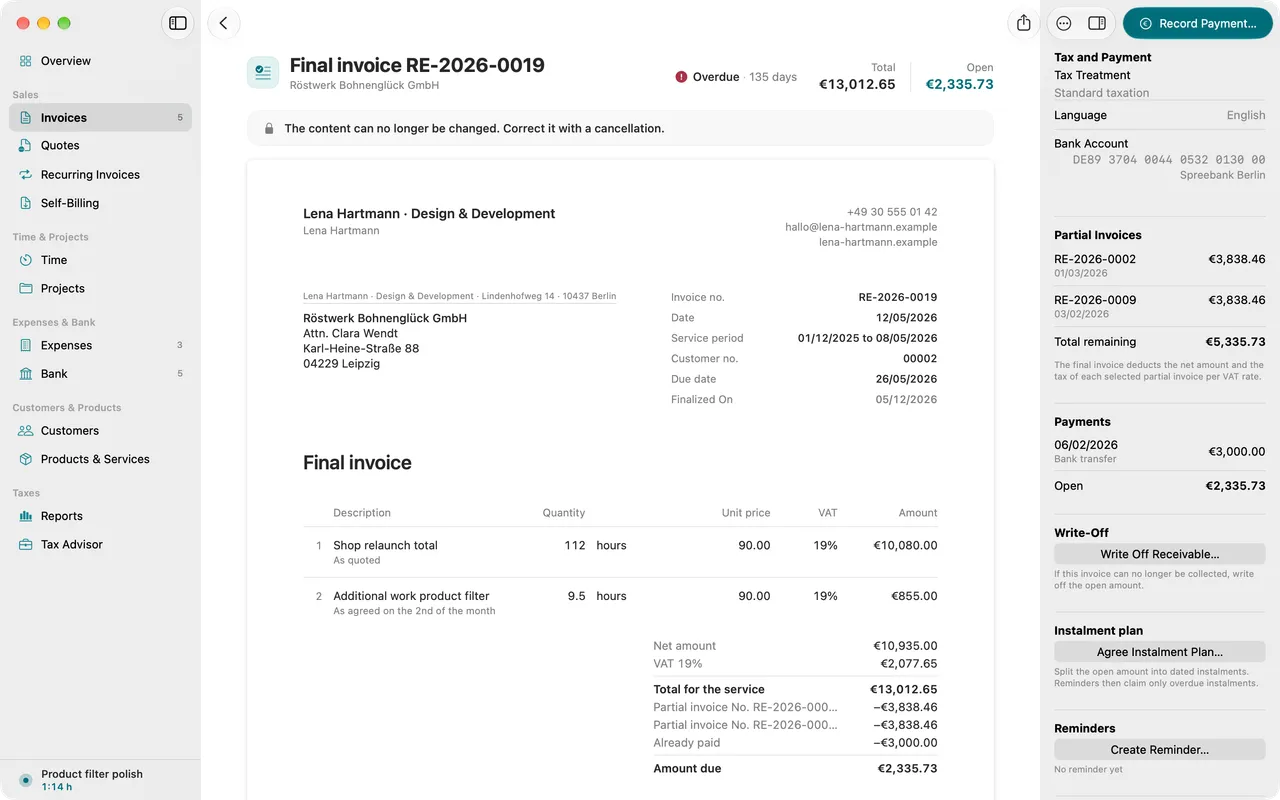
What partial invoices are for
A web project over four months, a photo production with weeks of preparation, a renovation: on larger jobs you often agree that your customer pays part of it in advance. For that you write a partial invoice (Abschlagsrechnung). It asks for part of the fee for work that is not finished yet. At the end, a final invoice (Schlussrechnung) bills the whole job and deducts what has already been paid.
How many partial invoices there are and how large they are is up to you and your customer. Ideally you put it in the quote.
What the partial invoice must show
An invoice for an advance payment follows the same rules as any invoice (section 14 (5) sentence 1 UStG). It needs all the mandatory details, with the VAT on the advance.
The date of the service is the one difference. Because the work has not been done yet, you state when you receive the money instead of the service date, provided that date is fixed and differs from the invoice date (section 14 (4) sentence 1 no. 6 UStG). If it is not fixed yet, a note that the service is still to be performed is common.
When VAT arises
Under accrual taxation, VAT normally arises at the end of the return period in which you performed the service. Advance payments are the exception: if the fee or part of it is received before the service is performed, VAT on that part arises at the end of the period in which the money comes in (section 13 (1) no. 1 (a) sentence 4 UStG). In German this is called Mindest-Ist-Versteuerung.
For you this means: a partial invoice nobody has paid yet does not belong in your VAT return. A payment received in March belongs in the return for March or for the first quarter. Under cash accounting (Ist-Versteuerung) the payment date counts anyway.
The final invoice
The final invoice bills the entire job, with all line items and the total fee. From that you deduct the advance payments you invoiced and received before, together with the VAT on them (section 14 (5) sentence 2 UStG). What remains is what your customer still pays.
An example at 19 % VAT with two paid partial invoices:
| Net | VAT | Gross | |
|---|---|---|---|
| Whole job | €10,000.00 | €1,900.00 | €11,900.00 |
| less 1st partial invoice | −€3,000.00 | −€570.00 | −€3,570.00 |
| less 2nd partial invoice | −€3,000.00 | −€570.00 | −€3,570.00 |
| Amount due | €4,000.00 | €760.00 | €4,760.00 |
If the job has line items at different tax rates, deduct the partial invoices per rate, so the VAT is right for each rate.
Common mistakes
- Deducting only the gross amount. If the final invoice shows VAT on the full €10,000 and below it just “less paid €7,140”, you show the VAT on the advance payments a second time. You owe that extra amount under section 14c (1) UStG until you correct the invoice.
- Deducting unpaid partial invoices. Deduct only what has actually been received. An open partial invoice stays open; the final invoice does not settle it.
- Skipping the final invoice. Even if the partial invoices already cover the whole amount, the final invoice closes the job and states the whole service with its service date.
- Changing a partial invoice afterwards. A partial invoice you sent stays as it is. If it is wrong, you correct or cancel it.
This guide explains the rules in general and does not replace advice from a tax advisor.
