

What the VAT return is
With the VAT return (Umsatzsteuer-Voranmeldung, UStVA) you tell the tax office, for a month or a quarter, how much VAT you charged your customers and how much input tax you may deduct from other businesses’ invoices. You pay the difference as a prepayment or get it refunded. You work out the amount yourself and file the return electronically (§ 18 Abs. 1 UStG).
After the year comes the annual VAT return, which takes up the returns of the year (§ 18 Abs. 3 UStG).
Under the small business rule (§ 19 UStG) you usually file no VAT return. The exception is a period in which you owe tax on services you received, for example under the reverse charge of § 13b UStG (§ 18 Abs. 4a UStG). More in the guide on the small business rule.
Monthly, quarterly or not at all
How often you file depends on last year’s VAT (§ 18 Abs. 2 UStG):
| VAT last year | Filing period |
|---|---|
| up to €2,000 | quarter; on request the tax office can release you |
| over €2,000 up to €9,000 | quarter |
| over €9,000 | month |
For new businesses the rule is monthly filing in the founding year and the year after (§ 18 Abs. 2 Satz 4 UStG). For the years 2021 to 2026 this is suspended (§ 18 Abs. 2 Satz 6 UStG). If you were active for only part of last year, you then scale its tax up to a full year. If you start this year, this year’s expected tax counts. Which rule applies from 2027 is something to check with your tax advisor when the time comes.
The tax office sets what applies to you. It is usually stated in the letter that gave you your tax number.
Deadlines and the permanent extension
The return is due on the 10th day after the end of the period, and so is the prepayment (§ 18 Abs. 1 UStG). For the third quarter that is 10 October, for January it is 10 February. If the day falls on a weekend or public holiday, the next working day applies (§ 108 Abs. 3 AO).
On request the tax office extends this deadline by one month, the permanent extension (Dauerfristverlängerung, § 46 UStDV). You apply electronically by the day the first return it should cover is due (§ 48 Abs. 1 UStDV).
Monthly filers only get the extension against a special prepayment. It is one eleventh of last year’s prepayments (§ 47 Abs. 1 UStDV) and is credited in the last return of the year (§ 48 Abs. 4 UStDV). Quarterly filers pay no special prepayment.
The main form fields
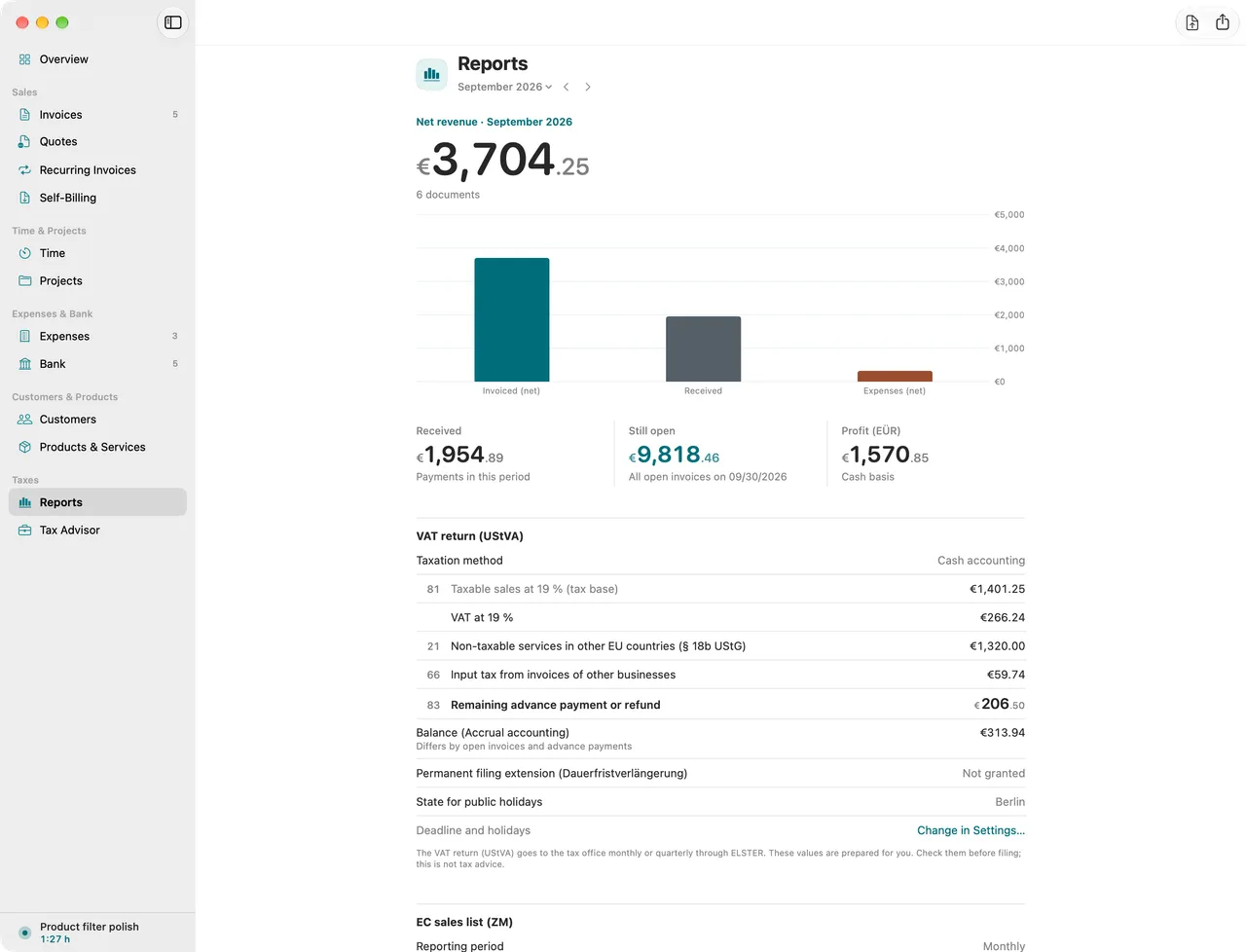
The form assigns every amount to a field number (Kennzahl). For freelancers only a few usually matter:
| Field | Content |
|---|---|
| 81 | Sales at 19 % (net) and the tax on them |
| 86 | Sales at 7 % |
| 41 | Intra-EU supplies of goods to businesses with a VAT ID |
| 21 | Services in other EU countries where the customer owes the tax |
| 45 | Other non-taxable sales, for example services to non-EU countries |
| 66 | Input tax from other businesses’ invoices |
| 83 | Remaining prepayment or refund |
Whether a sale counts depends on your accounting method. Under cash accounting (Ist-Versteuerung) the VAT counts when the money comes in, under accrual accounting (Soll-Versteuerung) when the service is performed. Which one applies to you is in your tax office letter, or ask your tax advisor.
The EC sales list
If you supply businesses in other EU countries, you also report them in the EC sales list (Zusammenfassende Meldung), per customer VAT ID. It goes to the Federal Central Tax Office and is due on the 25th day after its period ends (§ 18a UStG). The permanent extension does not apply to it.
Common mistakes
- The service is done but the invoice is still a draft: Folnaro counts only finalized invoices, while under accrual taxation the VAT still arises with the service.
- Receipts with input tax still unconfirmed in the inbox, so they are missing from field 66.
- The accounting method in your software does not match the one the tax office has on file.
- A return already filed is corrected without marking it as a corrected return.
The steps above show how to prepare the figures and bring them into Mein ELSTER. The page Taxes shows what Folnaro also prepares for the EÜR and the annual returns. This guide is not tax advice.
