

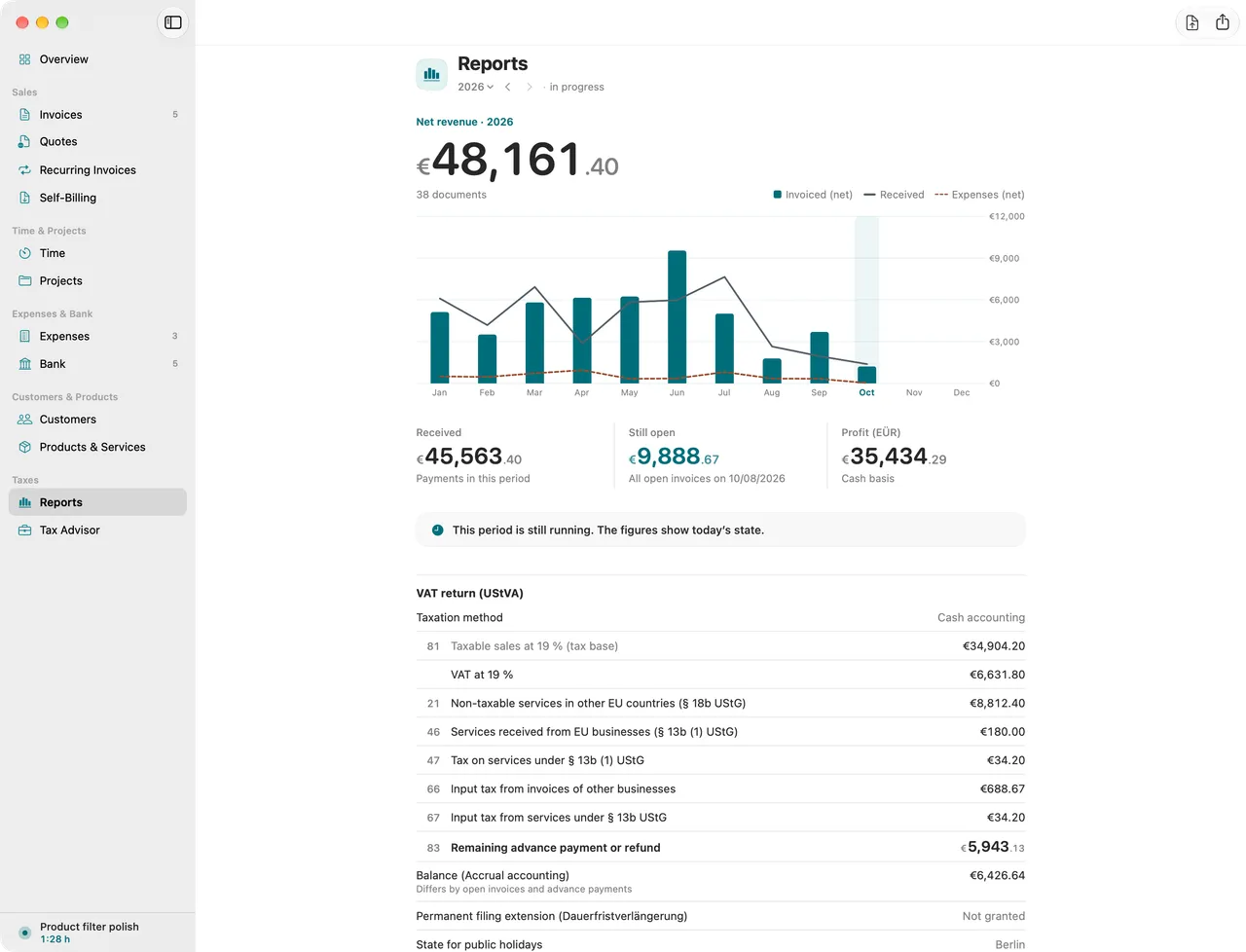
What the EÜR is
The profit statement is the simple way of working out profit in Germany. Instead of a balance sheet you set your business income against your business expenses, and the surplus is your profit (§ 4 Abs. 3 EStG). Most freelancers and many traders work out their profit this way.
The result goes into the Anlage EÜR, an official form with fixed lines. It is part of your income tax return.
Who may use it
§ 4 Abs. 3 EStG is open to everyone who is not required by law to keep books and draw up regular accounts, and who does not do so voluntarily.
- Freelancers in the sense of § 18 EStG (Freiberufler) are not covered by the bookkeeping duty of § 141 AO. They may use the EÜR whatever their turnover and profit.
- Traders (Gewerbetreibende) must keep books under § 141 Abs. 1 AO if their turnover in the calendar year exceeds €800,000 or their trading profit in the business year exceeds €80,000. The duty only starts with the business year after the tax office tells them (§ 141 Abs. 2 AO).
- Anyone who already has to keep books under other law, such as commercial law, draws up a balance sheet and does not use the EÜR.
Whether your work counts as freelance or as a trade is not always clear-cut. If in doubt, settle it with your tax advisor.
When income or an expense counts
The EÜR follows the receipt and payment principle (§ 11 EStG). Income counts in the year the money reaches you, an expense in the year you pay. When the invoice was written does not matter.
If you write an invoice on 15 December and the customer pays on 8 January, that is income of the new year.
VAT runs through the EÜR. The VAT your customers pay is business income. The input tax on your receipts and the VAT you pay to the tax office are business expenses. A refund from the tax office is income again. Under the small business rule these items do not arise.
The ten-day rule
§ 11 EStG makes an exception for regularly recurring income and expenses. If they flow a short time before the start or after the end of the year they economically belong to, they count in that year. Under the case law of the Federal Fiscal Court (BFH) a short time is up to ten days, so the window from 22 December to 10 January (BFH, VIII R 34/12).
The payment must also have been due within that window (BFH, VIII R 34/12, confirmed in VIII R 1/20). Typical cases are rent, insurance premiums and the VAT prepayment for December or the fourth quarter. With a permanent deadline extension the December prepayment is only due in February and therefore falls outside the rule. More in the guide on the VAT return.
Fixed assets and depreciation
If you buy something you use for several years, such as a computer, you usually do not deduct the cost at once but spread it over its useful life. Movable assets up to €800 net may be deducted in full in the year of purchase as low-value assets (§ 6 Abs. 2 EStG).
For the EÜR you keep a fixed asset register with purchase date, cost and depreciation.
Filing the Anlage EÜR
You file the EÜR electronically in the official data format (§ 60 Abs. 4 EStDV). Only in cases of hardship can the tax office allow paper on request. The deadline is that of the income tax return: seven months after the end of the year, so 31 July (§ 149 Abs. 2 AO). If a tax advisor prepares the return, a longer deadline applies (§ 149 Abs. 3 AO).
You keep the receipts behind the EÜR for eight years, your records and the EÜR itself for ten. More in the guide on retention periods. What Folnaro prepares for the EÜR is on the page Taxes.
This guide is not tax advice.
