The ten mandatory details
§ 14 (4) sentence 1 UStG lists what every invoice must show:
| No. | Detail | What to watch |
|---|---|---|
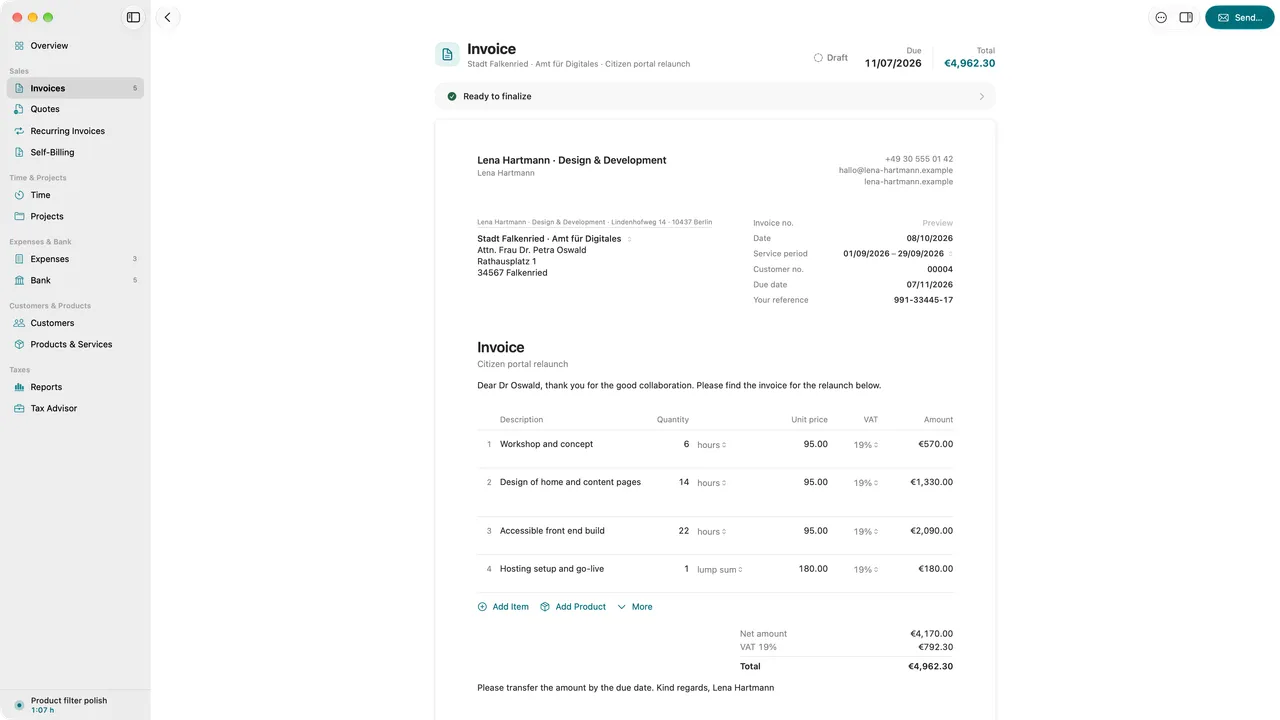
| 1 | full name and address of you and your customer | so both can be identified without doubt |
| 2 | your tax number or your VAT ID | either one is enough within Germany |
| 3 | issue date | the invoice date |
| 4 | sequential invoice number | unique, from one or more series |
| 5 | quantity and type of goods, or scope and type of service | precise enough that it is clear what you bill |
| 6 | date of the service | even if it is the same as the invoice date |
| 7 | net amount broken down by tax rate | plus reductions agreed in advance, such as an early payment discount |
| 8 | tax rate and tax amount | or a note on the tax exemption |
| 9 | note on the customer’s duty to keep the invoice | only for services connected with real estate to consumers |
| 10 | the word Gutschrift | only when your customer issues the invoice |
The invoice number
The number must be unique. The law asks for a sequential number from one or more series. So you may keep separate number ranges, for example for invoices and invoice corrections, as long as each number appears only once. Leading letters and years such as RE-2026- are common.
The service date
The service date is mandatory even when it matches the invoice date. A line such as “Service date equals invoice date” is then enough. Under § 31 (4) UStDV the calendar month in which you performed the service is sufficient. For longer jobs you state the service period.
Abbreviations and codes
Under § 31 (3) UStDV you may use abbreviations, letters, numbers or symbols for individual details, provided their meaning is clearly defined and available to both you and your customer.
The small-amount invoice up to €250
If the total of an invoice is no more than €250 gross, § 33 UStDV only requires:
- your full name and address
- the issue date
- quantity and type of goods, or scope and type of service
- the net amount and tax in one sum, plus the tax rate or a note on the tax exemption
The customer’s name, the invoice number, your tax number and the service date are then not required. Many include them anyway, if only to keep their own books tidy. The relief does not apply to reverse charge supplies under § 13b UStG. A small-amount invoice may always be sent as an other invoice, even under the e-invoicing mandate, see the e-invoicing mandate.
As a small business
If you use the small business rule under § 19 UStG, you show no VAT. § 34a UStDV sets out what your invoice needs: name and address of you and your customer, your tax number or VAT ID, the issue date, quantity and type of the service, the amount and a note that the small business exemption applies. A common wording is “Gemäß § 19 UStG wird keine Umsatzsteuer berechnet.”
If you show VAT anyway as a small business, you owe the amount shown (§ 14c (2) UStG). More in the guide to the small business rule.
Special cases
Reverse charge
When your customer owes the tax, for example for services to businesses in other EU countries, the note “Steuerschuldnerschaft des Leistungsempfängers” and both VAT IDs are added (§ 14a UStG). Details in the guide to reverse charge.
Self-billing: when your customer issues the invoice
In German VAT law a Gutschrift is an invoice that your customer, not you, issues for your service. This is a self-billing invoice, and it is only allowed if you agreed on it in advance (§ 14 (2) sentence 5 UStG). Typical examples are statements from platforms, publishers or app stores. Such an invoice must carry the word Gutschrift (§ 14 (4) sentence 1 no. 10 UStG).
In everyday German the word is often used for something else: a document that pays an amount back. For tax purposes that is an invoice correction or a cancellation invoice. Labeling it Gutschrift can make it look like a statement issued by the customer. How to correct properly is in the guide How to correct an invoice.
When you have to issue an invoice
For services to other businesses you must issue an invoice within six months of the service (§ 14 (2) sentence 2 UStG). For consumers you are usually not obliged to, but you may always write one.
If a detail is missing or wrong, you can correct the invoice. A document that refers clearly to the original invoice and contains the missing or corrected details is enough (§ 31 (5) UStDV).
Which further details your case needs, for example under commercial or company law, is a question for your tax advisor if in doubt.