

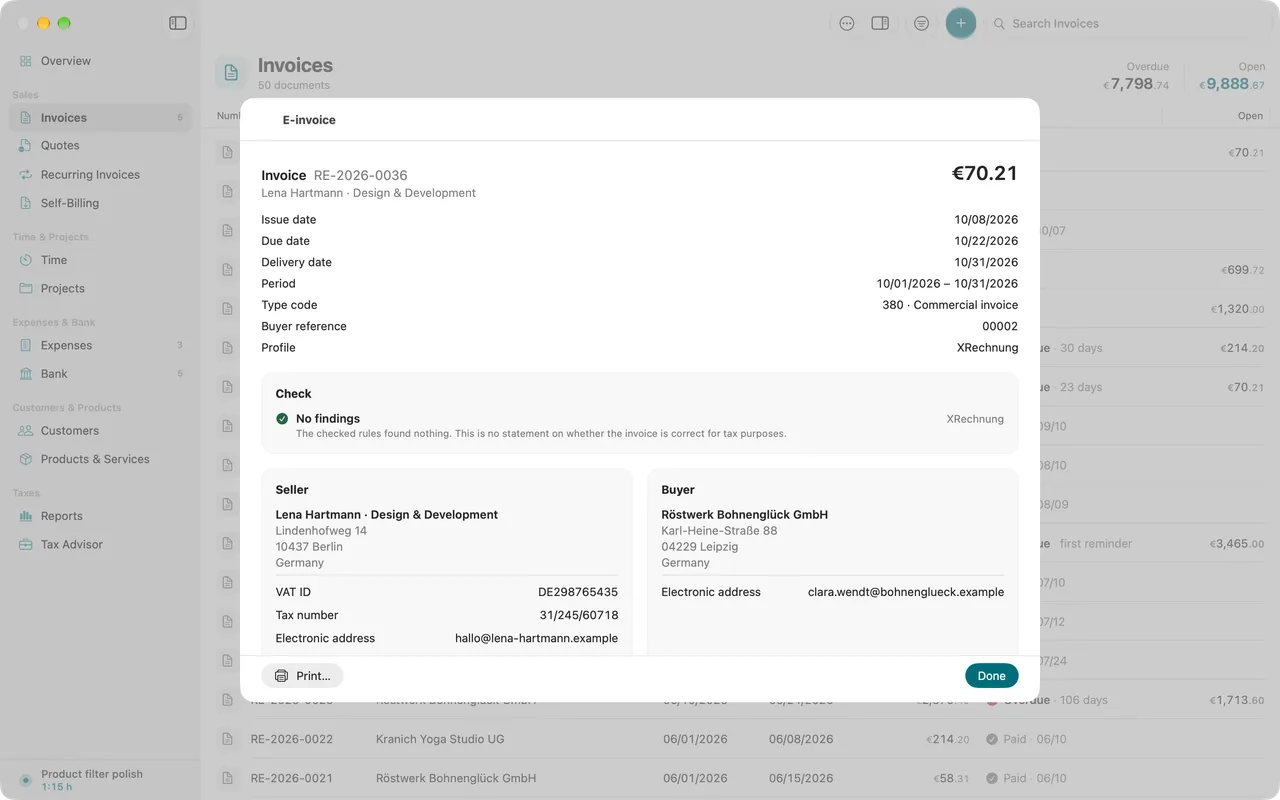
What counts as an e-invoice
Since the Growth Opportunities Act, § 14 (1) UStG distinguishes two kinds of invoice. An e-invoice is issued, sent and received in a structured format, so software can process it without anyone retyping it. The format has to follow the European standard for electronic invoicing, EN 16931, or be agreed between you and your customer and convert completely into such a format (§ 14 (1) sentences 6 and 7 UStG).
Everything else is an “other invoice” (sonstige Rechnung): paper, and also a PDF you send by email. A PDF looks digital, but the law does not count it as an e-invoice.
In practice the formats are called XRechnung and ZUGFeRD. According to the BMF letter of 15 October 2025, ZUGFeRD from version 2.0.1 meets the requirements, except for the MINIMUM and BASIC WL profiles. In a ZUGFeRD PDF the embedded XML is the actual invoice. The guide XRechnung vs. ZUGFeRD explains the difference.
The three steps at a glance
| Supply made | Receiving | Sending |
|---|---|---|
| from 1 January 2025 | you must be able to accept e-invoices | paper allowed, PDF and other formats with the customer’s consent |
| in 2026 | as in 2025 | as in 2025 |
| in 2027 | as in 2025 | e-invoice, unless your total turnover in the previous year was €800,000 or less |
| from 1 January 2028 | as in 2025 | e-invoice to every business in Germany |
The transition rules are in § 27 (38) UStG. What counts is the date of the supply, not the invoice date. If you invoice by EDI in 2027, you may keep using an EDI format that does not follow the standard until the end of 2027, with the recipient’s consent.
Receiving: what has been expected of you since 2025
There is no transition period for receiving. Every business in Germany must be able to accept e-invoices from other businesses, including small businesses and freelancers. According to the BMF letter of 15 October 2024, an email inbox is enough for that. You do not need a separate inbox just for e-invoices.
Accepting the file is only half of it. An XRechnung is an XML file you can hardly read without suitable software, so you need a program that displays and checks it. And you keep the XML file itself, not just a printout. How to do that on a Mac is in the guide How to open an XRechnung on a Mac.
The BMF letter of 15 October 2025 names three kinds of error: format errors, breaches of the standard’s business rules and content errors. A file with a format error is not an e-invoice but an other invoice. The letter recommends validating the e-invoices you receive.
Sending: who has to switch, and when
The mandate covers supplies to other businesses when both of you are established in Germany (§ 14 (2) sentence 2 no. 1 UStG). In that case you no longer need your customer’s consent to send the e-invoice electronically.
- Until the end of 2026 you may still invoice on paper. A PDF by email works if your customer agrees.
- In 2027 that only applies if your total turnover in the previous year did not exceed €800,000. Most freelancers are below that and get one more year.
- From 2028 every business customer in Germany gets an e-invoice.
Public bodies have had their own rule for a while. Federal authorities have required e-invoices under the E-Rechnungsverordnung for years, usually as XRechnung with a Leitweg-ID. Many federal states do the same.
The exceptions
You do not need an e-invoice in these cases:
- Invoices to consumers. The mandate only covers supplies to businesses.
- Small-amount invoices up to €250 gross. Under § 33 sentence 4 UStDV they may always be other invoices.
- Tickets for passenger transport.
- Tax-exempt supplies under § 4 nos. 8 to 29 UStG, such as medical treatment or insurance. The obligation in § 14 (2) sentence 2 UStG does not apply to them.
- Small businesses under § 19 UStG may keep writing other invoices permanently (§ 34a UStDV). They still have to be able to receive e-invoices. More in the guide on the small business rule.
Sending an e-invoice before you have to is allowed. Many customers appreciate it, because they can take over the data directly.
What you can do now
- Check that you can already read and keep e-invoices. That has been required since 2025.
- Look at your total turnover. It decides whether you switch in 2027 or in 2028.
- Complete the details an e-invoice needs for your business customers, such as the full address and an email address.
- Switch to ZUGFeRD before you have to. Nothing changes for your customers; they still get a readable PDF.
Whether an exception applies to you is a question for your tax advisor if in doubt. This guide does not replace individual advice.
