

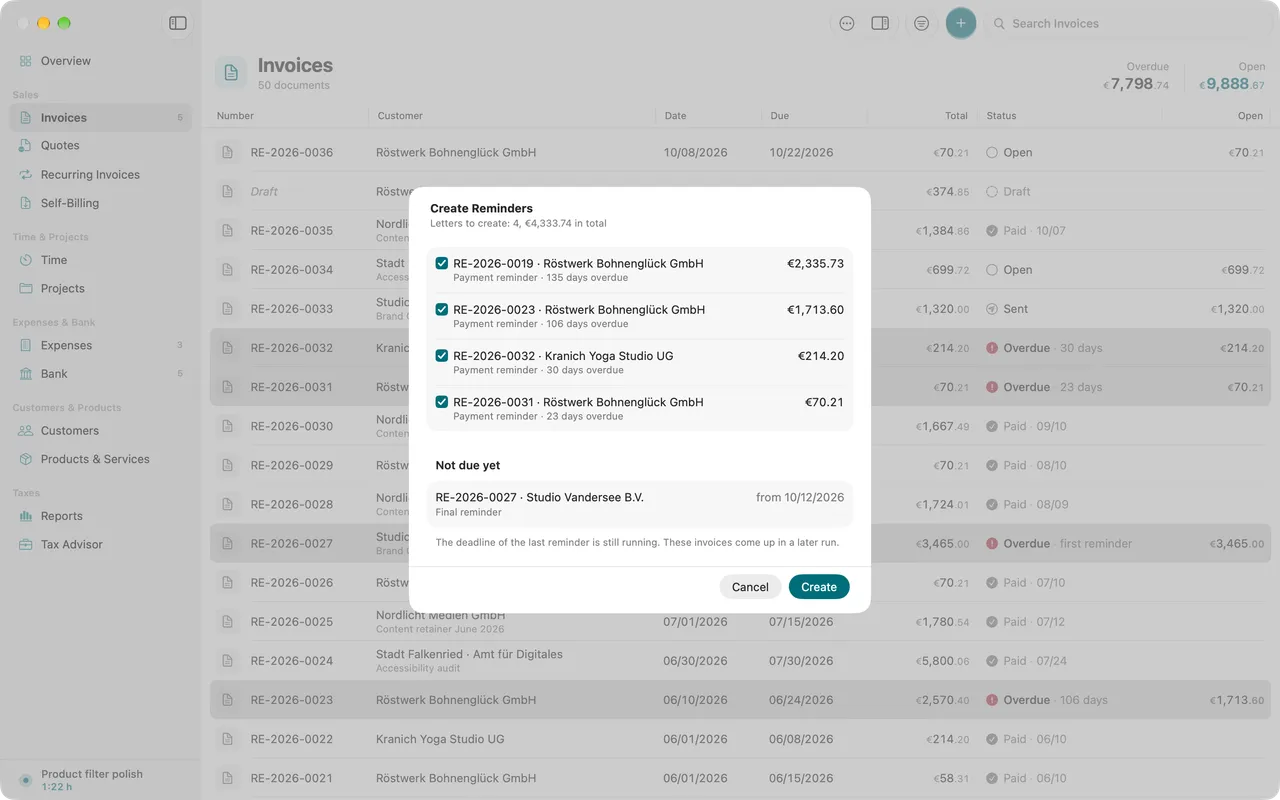
Remind first, then send a formal reminder
Often an invoice has simply been overlooked. A friendly payment reminder a few days after the due date usually sorts it out. German law prescribes no fixed levels. Three are common: the payment reminder (Zahlungserinnerung), the first reminder (1. Mahnung) and a final reminder that says further steps will follow.
Legally the heading does not matter. If your letter clearly asks for payment after the due date, it is a reminder in the legal sense (Mahnung), even if it is titled payment reminder.
When your customer is in default
Default (Verzug) is the point from which you may charge interest and costs. Section 286 of the German Civil Code (BGB) names three ways to get there:
- A reminder after the due date. If your customer does not pay after a reminder sent once the invoice is due, they are in default (section 286 (1) BGB).
- A fixed date. If the payment date is set by the calendar, such as an agreed “payable by 15 November”, no reminder is needed (section 286 (2) BGB). Payment terms you only print on your invoice are generally not enough for this.
- 30 days. For payment claims, the customer is in default at the latest 30 days after the due date and receipt of the invoice (section 286 (3) BGB). Towards consumers this applies only if the invoice specifically pointed out this consequence.
If you want to rely on the 30-day rule with private customers, put a sentence on the invoice, for example: “If you do not pay within 30 days of the due date and receipt of this invoice, you will be in default.”
What you may charge once they are in default
| Item | Consumers | Businesses | Basis |
|---|---|---|---|
| Default interest per year | base rate plus 5 percentage points | base rate plus 9 percentage points | section 288 (1) and (2) BGB |
| Lump sum | no | €40 | section 288 (5) BGB |
| Reminder fees | actual costs | actual costs | damages for default |
The base rate (Basiszinssatz) is defined in section 247 BGB. It changes on 1 January and 1 July, and the Deutsche Bundesbank publishes the current value. Check it there before you calculate interest. Interest runs by the day from the day of default.
You can charge the €40 lump sum to businesses that are in default with a payment claim, including on partial and instalment payments. It is offset against the costs of legal action, so reminder fees do not come on top; your customer owes the higher of the two amounts.
Reminder fees are damages. You can recover what the letter actually costs, such as postage and paper, but not your working time. The first reminder, the one that puts the customer in default, is not a consequence of default, so it costs your customer nothing.
What a good reminder looks like
- State the invoice number, invoice date and the open amount.
- List interest and fees separately, with rate and period.
- Set a new, clear deadline with a date, for example ten days.
- Attach the invoice again.
- Stay factual. Threats do not help, and a friendly tone keeps the relationship.
If nothing comes
After the final reminder there is the court procedure for a payment order (gerichtliches Mahnverfahren). You apply for a payment order (Mahnbescheid) online at the competent court. Mind the deadline: a reminder does not stop the limitation period. Claims usually become time-barred after three years (section 195 BGB), counted from the end of the year in which they arose and you knew about them (section 199 (1) BGB). It can be suspended by a payment order (section 204 (1) no. 3 BGB), a lawsuit or negotiations with your customer (section 203 BGB). A part payment or an acknowledgement makes it start again (section 212 BGB).
If a claim is disputed, for example because your customer finds fault with the work, a lawyer helps. This guide explains the rules in general and is not legal advice.
